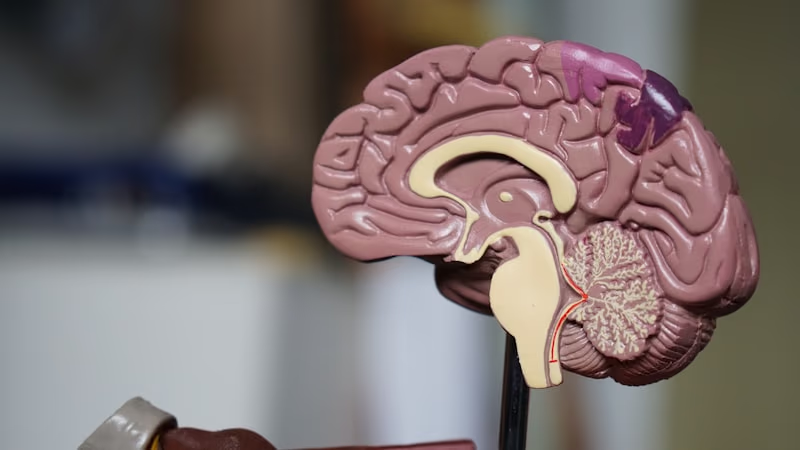

Most people think of hearing loss as an inconvenience — missing a few words at dinner, turning the TV up a little louder. But over the past decade, a growing body of research has revealed something far more serious: untreated hearing loss doesn't just affect your ears. It accelerates the decline of your brain. In 2020, The Lancet Commission on dementia prevention identified hearing loss as the single largest modifiable risk factor for dementia — bigger than smoking, depression, physical inactivity, or social isolation. That finding sent shockwaves through the medical community. And the research published since then has only strengthened the connection.
The Lancet Commission: Hearing Loss Is Risk Factor #1
In its landmark 2020 report — updated and reaffirmed in 2024 — The Lancet Commission identified 14 modifiable risk factors that together account for roughly 45% of all dementia cases worldwide. Hearing loss in midlife topped the list, responsible for an estimated 8% of attributable dementia risk on its own. To put that in perspective, that's more than any other single factor the commission examined, including traumatic brain injury (3%), hypertension (2%), excessive alcohol (1%), and obesity (1%).
This wasn't a fringe finding from a single study. The Lancet Commission synthesized evidence from dozens of large-scale epidemiological studies spanning multiple countries and decades. The conclusion was consistent: people with untreated hearing loss in midlife face a significantly elevated risk of developing dementia later in life. And the worse the hearing loss, the greater the risk.
The Johns Hopkins Research: Quantifying the Risk
Much of the foundational work linking hearing loss to cognitive decline comes from Dr. Frank Lin and his team at Johns Hopkins University. Their research, spanning more than 15 years, has produced some of the most cited findings in this field — and the numbers are hard to ignore.
In a pivotal 2011 study published in the Archives of Neurology, Lin's team followed 639 adults over nearly 12 years and found that mild hearing loss doubled the risk of dementia. Moderate hearing loss tripled it. And severe hearing loss increased the risk fivefold. A follow-up study in 2013, tracking over 1,900 older adults for six years, showed that those with hearing loss experienced cognitive decline 30-40% faster than those with normal hearing — even after controlling for age, sex, education, and other health conditions.
These weren't small, preliminary studies. They used validated cognitive assessments, audiometric testing, and rigorous statistical controls. The association between hearing loss and cognitive decline has since been replicated by research teams around the world, in populations ranging from Scandinavia to East Asia.
Three Mechanisms: How Hearing Loss Damages the Brain
Correlation isn't causation — and researchers have been careful to investigate why hearing loss and cognitive decline travel together so reliably. Three primary mechanisms have emerged, and they likely work in combination.
1. Cognitive Load Theory
When you can't hear clearly, your brain has to work overtime to fill in the gaps. Every conversation becomes a puzzle — decoding muffled speech, reading lips, inferring words from context. This constant effortful listening diverts cognitive resources away from other critical functions like memory encoding and executive processing. Over years, this chronic reallocation may exhaust the brain's cognitive reserves. Brain imaging studies have shown that people with hearing loss recruit frontal lobe areas (normally associated with higher-level thinking) just to process basic speech — areas that shouldn't need to be involved in simple listening.
2. Brain Atrophy
The brain operates on a use-it-or-lose-it principle. When auditory input decreases, the auditory cortex receives less stimulation — and it begins to shrink. A 2014 study by Lin's team using MRI scans found that adults with hearing loss showed accelerated rates of brain atrophy, particularly in the temporal lobe regions involved in speech and language processing. But the atrophy wasn't limited to auditory areas. It also affected regions involved in memory and sensory integration, suggesting a broader neurodegenerative cascade triggered by reduced sensory input.
3. Social Isolation
This is perhaps the most underappreciated pathway. When hearing becomes difficult, social interactions become exhausting and embarrassing. People with untreated hearing loss gradually withdraw — skipping gatherings, avoiding phone calls, disengaging from conversations. The research on social isolation and dementia risk is its own large body of evidence: a 2015 meta-analysis in the Journal of Neurology, Neurosurgery & Psychiatry found that social isolation increased dementia risk by approximately 50%. Hearing loss is one of the most potent drivers of social withdrawal in older adults, creating a vicious cycle: hearing loss leads to isolation, isolation accelerates cognitive decline, and cognitive decline makes hearing loss harder to manage.
The ACHIEVE Trial: Can Hearing Aids Slow Cognitive Decline?
If hearing loss accelerates dementia, the next logical question is whether treating it can slow things down. That's exactly what the ACHIEVE trial set out to answer — and it's the most important study in this space to date.
The Aging and Cognitive Health Evaluation in Elders (ACHIEVE) trial, led by Dr. Frank Lin and published in The Lancet in 2023, was a randomized controlled trial — the gold standard of clinical evidence. It enrolled 977 older adults aged 70-84 with untreated mild-to-moderate hearing loss and randomly assigned them to receive either hearing aids with audiological counseling or a health education control program.
The headline result: in a pre-specified subgroup of participants at higher risk for cognitive decline (those with more cardiovascular risk factors, lower baseline cognitive scores, or both), hearing aid intervention reduced the rate of cognitive decline by 48% over three years. That is a staggering effect size — larger than any pharmaceutical intervention for dementia prevention has achieved.
The overall trial population, which included many healthy older adults with robust cognitive reserves, didn't show the same dramatic effect. But that's expected — people who aren't declining yet can't show a slowdown in decline. The signal was clearest in the people who needed it most: those already on a trajectory toward cognitive impairment.
When to Start Monitoring Your Hearing (Earlier Than You Think)
Most people don't get their first hearing test until they notice a problem — which usually means the damage is already significant. Hearing loss is gradual, and the brain compensates remarkably well in the early stages. By the time you're struggling in conversations, you may have already lost years of optimal intervention time.
The American Speech-Language-Hearing Association recommends baseline hearing screenings for adults starting at age 50, with follow-ups every three years. But given the Lancet Commission's emphasis on midlife hearing loss (defined as ages 40-65) as the key risk window for dementia, many audiologists now recommend baseline testing at 40 — especially if you have any history of noise exposure, use headphones frequently, or have a family history of hearing loss.
Here's the uncomfortable truth: hearing loss typically begins 10-15 years before a person seeks help. The average American with hearing loss waits seven years before getting hearing aids. Every one of those years represents continued cognitive strain, potential brain atrophy, and increased social withdrawal. Early detection isn't just good practice — given what we now know about the cognitive consequences, it may be one of the most impactful things you can do for long-term brain health.
The Dual Benefit: Social and Cognitive Protection
Addressing hearing loss delivers benefits that compound in ways most people don't anticipate. The cognitive benefits — reduced listening effort, maintained brain volume, preserved cognitive reserves — are significant on their own. But the social benefits may be equally important.
People who treat their hearing loss report staying more engaged with family and friends, maintaining independence longer, experiencing lower rates of depression, and feeling more confident in daily interactions. A 2020 study in the Journal of the American Geriatrics Society found that hearing aid use was associated with a 19% lower risk of long-term cognitive decline, a 13% reduced risk of depression, and a significant reduction in falls.
Social engagement is one of the most powerful protective factors against dementia. When hearing loss is treated and social participation is restored, you're essentially reinforcing two of the strongest defenses your brain has. The cognitive and social benefits aren't separate — they're part of the same protective loop.
What Supplements Can and Can't Do Here
Given the stakes, it's natural to wonder whether nutritional supplements can help protect both hearing and cognitive function. The honest answer: they may play a supporting role, but they are not a substitute for hearing treatment or medical care.
Certain nutrients have research behind them for hearing protection. Magnesium has shown benefit in reducing noise-induced hearing damage. Antioxidants like NAC and alpha-lipoic acid may help protect cochlear hair cells from oxidative stress. Omega-3 fatty acids and folate have been associated with lower rates of age-related hearing decline in observational studies. These same nutrients also have evidence for supporting brain health — there is genuine overlap.
But here's what supplements cannot do: they cannot reverse existing hearing loss, they cannot replace hearing aids, and they cannot undo the cognitive consequences of years of untreated hearing problems. If you're experiencing hearing loss and taking a supplement instead of seeing an audiologist, you're addressing the smaller issue while ignoring the larger one. The most effective approach treats hearing loss directly — and then considers supplements as one component of an overall health strategy.
Looking Into Hearing Health Supplements?
We've reviewed the most popular hearing support supplements on the market, examining their ingredients, dosages, and the clinical evidence behind them. If supplements are part of your strategy, start with the facts.
See Hearing Health ReviewsPractical Action Steps You Can Take Now
The research is clear enough to act on. Here's what the evidence supports.
- Get a baseline hearing test. If you're over 40, schedule an audiometric evaluation. If you're over 50 and haven't had one, make it a priority. This is the single most actionable step on this list.
- Don't delay treatment. If testing reveals hearing loss, discuss options with your audiologist immediately. The ACHIEVE trial showed that early intervention matters — and every year of delay is a year of preventable cognitive strain.
- Protect your remaining hearing. Use hearing protection in noisy environments, follow the 60/60 rule for headphones (no more than 60% volume for no more than 60 minutes), and give your ears recovery time after noise exposure.
- Stay socially engaged. Make a conscious effort to maintain social connections. If hearing difficulty is causing you to withdraw, that's a red flag — and another reason to address the hearing loss directly.
- Support overall brain health. Regular exercise, adequate sleep, a Mediterranean-style diet, cognitive engagement, and managing cardiovascular risk factors all contribute to cognitive resilience. These complement hearing treatment — they don't replace it.
- Consider supplements as part of a broader strategy. Nutrients like magnesium, omega-3s, and antioxidants may offer modest protective benefit for both hearing and brain health. But use them alongside medical care, not instead of it.
The Bottom Line
The link between hearing loss and cognitive decline is no longer a theory or a preliminary finding. It's one of the most robust associations in aging research, backed by decades of epidemiological data, neuroimaging studies, and now a landmark randomized controlled trial. Hearing loss doesn't just make the world quieter — it makes your brain work harder, shrink faster, and lose its connections to the social world that keeps it sharp.
The encouraging part of this story is that it's actionable. Unlike many dementia risk factors, hearing loss is treatable. Hearing aids work. Early detection matters. And the cognitive payoff of addressing hearing loss — potentially cutting the rate of decline nearly in half — is among the most powerful preventive interventions available for brain health today. If you've been putting off a hearing test, the research is telling you clearly: your brain can't afford to wait.
Looking for Hearing Health supplements?
Our experts have reviewed and compared the top hearing health supplements to help you find the right one.
See our expert comparisonFrequently Asked Questions
How much does hearing loss increase dementia risk?
According to research from Johns Hopkins, mild hearing loss doubles the risk of dementia, moderate hearing loss triples it, and severe hearing loss increases the risk fivefold. The Lancet Commission identified hearing loss as the single largest modifiable risk factor for dementia, accounting for an estimated 8% of all cases.
Can hearing aids prevent dementia?
Hearing aids can't guarantee dementia prevention, but the ACHIEVE trial — the first large-scale randomized controlled trial on this question — found that hearing aid use reduced the rate of cognitive decline by 48% over three years in at-risk older adults. This is strong evidence that treating hearing loss meaningfully slows cognitive decline.
At what age should I start getting hearing tests?
The American Speech-Language-Hearing Association recommends baseline screenings starting at age 50. However, given that midlife hearing loss (ages 40-65) is the critical risk window identified by The Lancet Commission, many audiologists now recommend baseline testing at 40 — especially if you have noise exposure history, frequently use headphones, or have a family history of hearing loss.
Why does hearing loss cause brain atrophy?
The brain follows a use-it-or-lose-it principle. When hearing declines, the auditory cortex receives less stimulation and begins to shrink. MRI studies show that this atrophy extends beyond auditory areas into regions responsible for memory and sensory integration. Additionally, the constant effort to decode degraded speech diverts cognitive resources from other brain functions like memory and executive processing.
Can supplements help with both hearing and cognitive decline?
Certain nutrients like magnesium, omega-3 fatty acids, antioxidants, and folate have research supporting a protective role for both hearing and brain health. However, supplements cannot reverse existing hearing loss or replace hearing aids. They're best used as one component of a broader strategy that includes professional hearing care, noise protection, and overall health management.