
Noise-induced hearing loss (NIHL) is one of the most common — and most preventable — forms of permanent sensory damage worldwide. According to the CDC, approximately 40 million American adults aged 20 to 69 have hearing damage consistent with noise exposure. What makes it particularly insidious is that it happens gradually and painlessly. There's no sharp moment where you realize you've lost something. The high frequencies fade first: birds singing, consonants in speech, the beep of a microwave. By the time you notice, years of damage have already accumulated. The good news is that understanding how noise damages hearing gives you a real shot at preventing it.
How Noise Actually Damages Your Hearing
To understand NIHL, you need to know a little about the cochlea — the snail-shaped organ deep in your inner ear. Inside the cochlea are roughly 15,000 to 20,000 hair cells (stereocilia) arranged along the basilar membrane. These microscopic cells convert sound vibrations into electrical signals that travel via the auditory nerve to the brain. Different regions of the cochlea respond to different frequencies: the base handles high-pitched sounds, while the apex processes low-pitched ones.
When sound is too loud or lasts too long, the mechanical force overwhelms these hair cells. They bend, swell, and eventually break. Unlike birds and reptiles, humans cannot regenerate damaged hair cells — once they're destroyed, they're gone permanently. Loud noise also triggers a flood of free radicals (reactive oxygen species) in the cochlea, causing oxidative damage that continues for hours or even days after the noise exposure has ended. This is why you might notice worsening symptoms the morning after a loud concert rather than during it.
Recent research has also identified a subtler form of damage called "hidden hearing loss" or cochlear synaptopathy. In this scenario, the hair cells survive, but the synaptic connections between the hair cells and the auditory nerve fibers are damaged. Standard hearing tests may come back normal, yet the person struggles to understand speech in noisy environments. A 2019 study published in The Journal of Neuroscience confirmed that noise exposure can cause this synapse damage even at exposure levels previously considered safe.
Common Sources of Damaging Noise
Sound intensity is measured in decibels (dB). Normal conversation sits around 60 dB. Hearing damage begins with sustained exposure above 85 dB, and the relationship between volume and safe exposure time is logarithmic — every 3 dB increase halves the safe duration. At 85 dB, you have roughly 8 hours before damage starts. At 88 dB, that drops to 4 hours. At 100 dB, you've got about 15 minutes. At 110 dB, just 2 minutes.
Here's where common noise sources fall on that scale. City traffic and a busy restaurant typically hit 80-85 dB — right at the threshold. A gas-powered lawnmower or leaf blower runs 90-100 dB. Power tools like circular saws and angle grinders reach 100-110 dB. A rock concert or a nightclub with the bass cranked averages 100-115 dB. Firearms are among the worst offenders: a single gunshot produces 140-170 dB, enough to cause immediate permanent damage without hearing protection.
But the fastest-growing source of NIHL in 2026 is personal audio devices. The WHO estimates that over 1 billion young adults globally are at risk from unsafe listening habits. Most earbuds can push 100-110 dB at maximum volume. People wearing regular earbuds on a subway or in a gym instinctively raise the volume to overpower background noise — often hitting 95-105 dB without realizing it. Over months and years, this adds up.
Early Warning Signs You Shouldn't Ignore
NIHL doesn't announce itself with a sudden pop. It creeps in. Here are the warning signs that suggest your hearing is being affected — and that you should take action before more damage accumulates.
- Ringing, buzzing, or hissing in your ears after noise exposure (temporary tinnitus) — this is your cochlea's distress signal
- Sounds seem muffled or "dull" after being in a loud environment, even after a few hours of quiet
- Difficulty understanding speech in noisy settings like restaurants, even though you hear fine in quiet rooms
- Needing to turn the TV or phone volume higher than others around you
- Asking people to repeat themselves more frequently, especially women and children (whose voices are higher-pitched)
- A persistent, low-level tinnitus that doesn't go away — even in silence
- Feeling like people are mumbling, when in reality your high-frequency hearing has declined
If you recognize two or more of these, it's worth getting a baseline audiogram. The test is quick, painless, and covered by most insurance plans. Early detection doesn't reverse damage, but it gives you the data to make better decisions going forward.
Prevention Strategies That Actually Work
The single most effective strategy for preventing NIHL is reducing exposure — either by lowering the volume or shortening the duration. Everything else is secondary.
Wear Hearing Protection
Foam earplugs cost under a dollar and reduce noise by 15-33 dB depending on the fit. They're not glamorous, but they work. For situations where you need to hear clearly (concerts, conversations, music practice), custom-molded musician's earplugs from an audiologist reduce volume evenly across frequencies — so music sounds like music, just quieter. These typically run $100-200 and last for years. For occupational noise (construction, manufacturing, shooting), over-ear muffs with a Noise Reduction Rating (NRR) of 25+ are the standard.
Follow the 60/60 Rule for Headphones
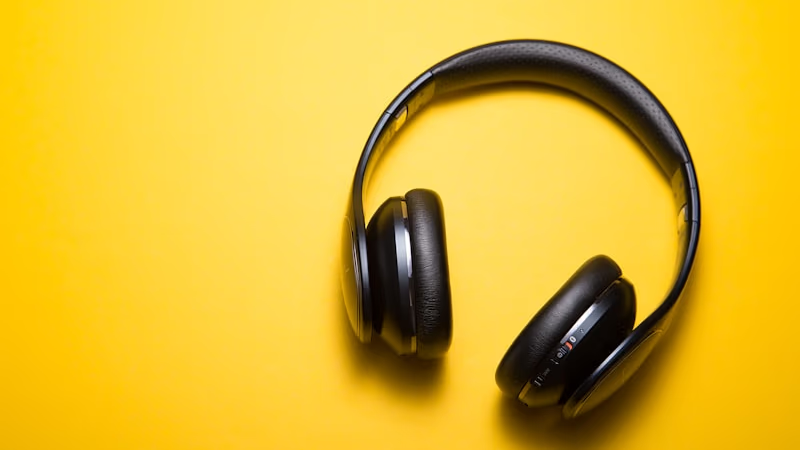
Keep your headphone volume at or below 60% of maximum, and limit listening sessions to 60 minutes before taking a 5-10 minute break. Most modern smartphones (both iOS and Android) have built-in volume limit settings and exposure tracking — enable them. And seriously consider investing in noise-canceling headphones. By reducing ambient noise, they eliminate the need to crank volume to unsafe levels.
Give Your Ears Recovery Time
After exposure to loud noise, hair cells need at least 16 hours of relative quiet to recover. If you go to a loud concert on Friday night and then mow the lawn Saturday morning, you're compounding the damage before your ears have had a chance to heal. Space out your loud-noise exposures whenever possible. If you work in a noisy environment, avoid additional loud recreational noise on the same day.
Can Damaged Hearing Recover?
This is the question everyone wants answered, and the honest answer is: it depends on the type and extent of the damage.
Temporary threshold shift (TTS) — that muffled feeling after a concert — typically recovers within 24-72 hours. The hair cells were stressed and bent, but not destroyed. If you consistently let your ears recover, they bounce back. However, repeated TTS episodes accumulate over time. Think of it like sunburns: each one causes a little more permanent damage, even after the visible burn heals.
Permanent threshold shift (PTS) — measurable hearing loss that doesn't recover — means hair cells have died. In humans, this is currently irreversible. No drug, supplement, or therapy can regenerate human cochlear hair cells in 2026. However, research is advancing. Clinical trials using gene therapy (notably the FX-322 drug from Frequency Therapeutics and similar approaches) have explored progenitor cell activation to regrow hair cells. Results have been mixed so far, but the field is moving. For now, hearing aids and cochlear implants remain the primary interventions for significant sensorineural hearing loss.
Hidden hearing loss (synaptopathy) is a newer area of study, and recovery prospects are less clear. Some animal studies suggest partial synaptic regeneration is possible, but human data is limited. What is clear is that this type of damage makes it harder to follow conversations in background noise — one of the earliest and most frustrating functional impacts of NIHL.
When to See a Doctor
Don't wait until you can't hear conversations to get checked. Schedule an appointment with an audiologist or ENT specialist if you experience any of the following: tinnitus that persists for more than a week, sudden hearing loss in one or both ears (this is a medical emergency — seek treatment within 72 hours), difficulty understanding speech even in relatively quiet settings, a noticeable change in your hearing after a noise exposure that doesn't resolve within a couple of days, or if you work in a loud environment and haven't had a hearing test in the past two years.
An audiogram — a quick, painless test — can identify the type and severity of any hearing loss and establish a baseline for future comparison. If you're in your 30s or 40s, getting a baseline now is one of the smartest preventive health moves you can make.
The Role of Supplements in Hearing Protection
No supplement can replace hearing protection or undo significant noise damage. That needs to be said clearly. But there is a growing body of research suggesting that certain nutrients may provide a layer of biochemical protection against noise-induced oxidative damage — particularly when taken before or shortly after noise exposure.
Magnesium is the most studied. A well-known 1994 study published in the American Journal of Otolaryngology found that military recruits who received magnesium supplements during basic training had significantly less noise-induced hearing loss than the placebo group. The proposed mechanism: magnesium improves blood flow to the cochlea and helps regulate the glutamate signaling that becomes excitotoxic during loud noise exposure. Several subsequent studies have replicated the protective effect, though results vary based on dosage, timing, and the noise levels involved.
N-acetylcysteine (NAC) is another compound with real research behind it. NAC is a precursor to glutathione, the body's primary endogenous antioxidant. The U.S. military has funded multiple studies on NAC for preventing noise-induced hearing loss in service members. A 2014 clinical trial published in Clinical Pharmacology & Therapeutics showed that NAC reduced temporary threshold shifts after noise exposure when taken within a specific time window. The timing appears to matter — NAC seems most effective when taken before or shortly after noise exposure, not days later.
Other nutrients being studied include alpha-lipoic acid (another antioxidant), acetyl-L-carnitine (which may protect mitochondrial function in hair cells), and vitamins A, C, and E in combination. A 2007 study in Free Radical Biology and Medicine found that a combination of vitamins A, C, E plus magnesium was more protective against noise-induced hearing loss than any single nutrient alone.
Exploring Hearing Health Supplements?
We've reviewed several supplements formulated for hearing support, analyzing their ingredients against published research. If you're considering a hearing supplement, our reviews can help you separate evidence from marketing.
See Hearing Health ReviewsProtecting the Next Generation
Noise-induced hearing loss is increasingly a young person's problem. A CDC analysis found that nearly 1 in 4 adults aged 20 to 69 who reported good hearing already showed measurable noise damage on audiometry. Among teenagers, the prevalence of high-frequency hearing loss has risen by roughly 30% over the past two decades — driven largely by earbuds and headphone culture.
If you have kids or teenagers, setting volume limits on their devices isn't overprotective — it's responsible. Both iOS (Screen Time > Reduce Loud Audio) and Android (Sound & Vibration > Media Volume Limiter) offer built-in controls. Have the conversation early. Explain that hearing damage is permanent and cumulative. Give them quality noise-canceling headphones for birthdays instead of cheap earbuds. It's one of those long-game investments that pays off across an entire lifetime.
The Bottom Line
Noise-induced hearing loss is permanent, cumulative, and largely preventable. The mechanics are simple: excessive noise destroys irreplaceable hair cells in your cochlea, and no technology in 2026 can bring them back. But the prevention toolkit is equally straightforward — wear protection in loud environments, keep headphone volume below 60%, give your ears recovery time after noise exposure, and maintain good cardiovascular health.
If you're already noticing signs — persistent tinnitus, difficulty with speech in noise, muffled hearing after loud events — get a baseline audiogram and start taking protection seriously today. The damage you prevent now is hearing you'll still have in 20 years. That's a trade worth making.
Looking for Hearing Health supplements?
Our experts have reviewed and compared the top hearing health supplements to help you find the right one.
See our expert comparisonFrequently Asked Questions
How loud is too loud?
Sustained exposure above 85 decibels can cause hearing damage over time. A simple rule: if you need to raise your voice to be heard by someone standing 3 feet away, the ambient noise is likely above 85 dB and you should wear hearing protection. Smartphone apps like NIOSH SLM and Decibel X can give you a rough reading of your environment's noise level.
Can noise-induced hearing loss happen from a single event?
Yes. Sudden, extremely loud sounds — like a gunshot (140-170 dB), an explosion, or standing next to a speaker at a concert — can cause immediate permanent damage. This is called acoustic trauma. It can cause instant hearing loss, tinnitus, or both. Always wear hearing protection around firearms and industrial explosions, with no exceptions.
Is noise-induced hearing loss different from age-related hearing loss?
They're related but distinct. Age-related hearing loss (presbycusis) is a gradual decline driven by the aging of cochlear structures and typically affects both ears symmetrically, starting with high frequencies. Noise-induced hearing loss follows the same high-frequency pattern but can occur at any age and is directly caused by excessive sound exposure. In practice, many people experience a combination of both by their 50s and 60s.
Do earplugs actually prevent hearing loss?
When used correctly, yes — they're highly effective. Properly fitted foam earplugs reduce noise by 15-33 dB, which can bring a 100 dB concert down to a safe 67-85 dB range. The key is proper insertion: roll the foam plug tightly, pull your ear up and back to straighten the ear canal, insert the plug, and hold it for 20-30 seconds while it expands. Improperly inserted earplugs may only reduce noise by 5-10 dB.
Can supplements reverse noise-induced hearing loss?
No supplement can reverse permanent sensorineural hearing loss — once hair cells are destroyed, they don't regenerate. However, some research suggests that certain nutrients like magnesium and NAC (N-acetylcysteine) may provide a degree of protection against noise damage when taken before or shortly after exposure. These work by reducing oxidative stress and improving cochlear blood flow. They're a potential complementary measure, not a replacement for hearing protection.