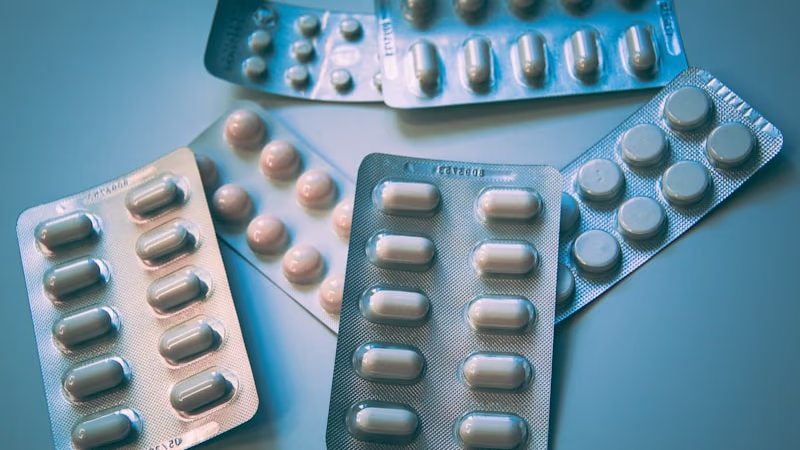

The supplement industry pulls in over $60 billion a year in the United States alone. It's also one of the least regulated consumer product categories you can buy. The FDA doesn't approve supplements before they hit shelves. Companies can make vague health claims without proving them. And the label — the one thing standing between you and a bottle of expensive sawdust — is designed to look trustworthy whether the product is legit or not. The good news? Once you know what to look for, reading a supplement label takes about 90 seconds and can save you hundreds of dollars a year on products that don't deliver. Let's break it down.
The Supplement Facts Panel: Your First Line of Defense
Every supplement sold in the U.S. is required to have a Supplement Facts panel. It looks similar to the Nutrition Facts label on food, but there are key differences. Here's what each section actually tells you — and what it conveniently leaves out.
Serving Size
This is where companies play their first trick. A label might show impressive dosages until you realize the serving size is three capsules, not one. That bottle of 60 capsules? It's a 20-day supply, not a two-month supply. Always check the serving size first and do the math on cost per serving, not cost per bottle. A $30 bottle that lasts 20 days is more expensive per day than a $50 bottle that lasts 60 days.
Amount Per Serving and % Daily Value
The Amount Per Serving column shows you how much of each ingredient you're getting in one serving. The % Daily Value (DV) column shows how that amount compares to the recommended daily intake set by the FDA. If a vitamin shows 5000% DV, that's not a selling point — it means the dose is 50 times what most people need, and your body is going to excrete most of it anyway. For water-soluble vitamins like B12 and Vitamin C, mega-doses are mostly harmless (and mostly useless). For fat-soluble vitamins like A, D, E, and K, consistently exceeding the DV can actually be dangerous because they accumulate in your body.
If an ingredient shows a dagger symbol (†) instead of a percentage, that means no Daily Value has been established by the FDA. This is common for herbs, botanicals, and newer compounds like CoQ10 or ashwagandha. It doesn't mean the ingredient is sketchy — it just means you'll need to look at clinical research to know what an effective dose looks like.
The Proprietary Blend Problem
If there is one single red flag that should make you skeptical of a supplement, it's the phrase "Proprietary Blend" on the label. Here's why: when a company uses a proprietary blend, they're only legally required to list the total weight of the blend and the individual ingredients in order of predominance. They do not have to tell you how much of each ingredient is in the blend.
Let's say a proprietary blend weighs 500mg and lists "green tea extract, garcinia cambogia, caffeine, cayenne pepper." The green tea extract could be 490mg and the other three could be 3-4mg each — essentially dust. Or they could be evenly distributed. You have no way of knowing. The company will tell you the blend is "proprietary" to protect their formula from competitors. In reality, most supplement formulas aren't exactly state secrets. The real reason is usually that disclosing individual doses would reveal that the product is underdosed on the expensive ingredients.
Reputable companies disclose individual ingredient amounts. Full stop. If a brand won't tell you exactly how much of each ingredient you're paying for, ask yourself why.
"Other Ingredients" — The Fine Print That Matters
Below the Supplement Facts panel, you'll find the "Other Ingredients" section. These are the inactive ingredients — fillers, binders, flow agents, colorings, and capsule materials. Most are harmless. Some are worth paying attention to.
- Magnesium stearate — This is a flow agent used in manufacturing to prevent ingredients from sticking to machinery. The internet has decided it's toxic, but the actual evidence says otherwise. The amounts used in supplements are tiny and well within safety limits. This is not the hill to die on.
- Silicon dioxide — Another flow agent. It's literally sand. In the microscopic amounts used in supplements, it passes through your system without issue.
- Titanium dioxide — A whitening agent used in some tablets and capsules. The EU banned it as a food additive in 2022 over potential genotoxicity concerns, though the FDA still allows it. If you want to be cautious, it's reasonable to avoid this one.
- Artificial colors (FD&C dyes) — These serve zero functional purpose in a supplement. They exist purely for aesthetics. Quality brands skip them entirely.
- Hydrogenated oils — Occasionally used as fillers. There's no good reason for these to be in a supplement, and their presence suggests cost-cutting.
- Carrageenan — A thickener derived from seaweed. Some research links it to gastrointestinal inflammation, though the evidence is mixed. Many quality brands have moved away from it.
What FDA Regulation Actually Means for Supplements (Spoiler: Not Much)
Here's the part the supplement industry hopes you never fully understand: dietary supplements are regulated under the Dietary Supplement Health and Education Act of 1994 (DSHEA). Under this law, supplements are treated more like food than drugs. Companies don't need FDA approval before selling a supplement. They don't need to prove the product works. They don't even need to prove that what's on the label matches what's in the bottle.
The FDA can only take action after a product hits the market — usually after adverse event reports pile up or independent testing reveals contamination. The FTC handles advertising claims, but enforcement is reactive and slow. When you see "FDA approved" on a supplement label, that's actually a violation of FDA rules, because the agency doesn't approve supplements. If a company is lying about that on the front of the bottle, imagine what else they're comfortable lying about.
What the FDA does require: Good Manufacturing Practices (GMPs), which set standards for facility cleanliness, ingredient identity testing, and labeling accuracy. But GMP inspections don't happen frequently for every facility, and violations are common. In 2023, the FDA found GMP violations in more than half the supplement manufacturing facilities it inspected.
Third-Party Testing Certifications: The Gold Standard
Since the FDA doesn't verify supplement contents before they reach you, third-party testing organizations fill that gap — at least for companies willing to pay for the scrutiny. Here's what each major certification actually means.
- USP (United States Pharmacopeia) — The most rigorous certification available. USP tests for ingredient identity, potency, purity, and dissolution (whether the tablet actually breaks down in your body). They also audit manufacturing facilities. If a supplement has the USP Verified mark, it's been through serious quality control.
- NSF International — Tests for contaminant levels, label accuracy, and GMP compliance. Their "Certified for Sport" program is specifically designed for athletes who need to avoid banned substances. Also very reputable.
- ConsumerLab — An independent testing company that buys products off shelves and tests them. Their seal means the product passed testing for identity, potency, and purity. They also publish detailed comparison reports. A ConsumerLab subscription is one of the smartest investments a supplement buyer can make.
- Informed Sport / Informed Choice — Primarily focused on ensuring products are free from substances banned in athletic competition. Good for athletes, but less comprehensive for general consumers.
- GMP Certified — This is the baseline, not a badge of honor. It means the facility follows basic manufacturing standards. Any supplement company should have this. Bragging about GMP compliance is like a restaurant bragging about passing a health inspection.
Bioavailability: The Forms Matter More Than the Dose
A label might show 400mg of magnesium, but not all magnesium is created equal. The form of an ingredient determines how much your body actually absorbs and uses. Here's where it gets important — and where cheap supplements cut corners.
- Magnesium oxide vs. magnesium glycinate — Magnesium oxide is dirt cheap to produce and has roughly 4% bioavailability. Magnesium glycinate absorbs significantly better and is gentler on the stomach. If your magnesium supplement uses oxide, you're paying for a laxative, not a mineral supplement.
- Zinc picolinate vs. zinc sulfate — Picolinate and gluconate forms are absorbed well. Zinc sulfate is cheaper but harder on the stomach and less bioavailable. Zinc oxide is the worst absorbed form commonly found in supplements.
- Vitamin D3 vs. D2 — D3 (cholecalciferol) is the form your body produces naturally from sunlight and is significantly more effective at raising blood levels than D2 (ergocalciferol). If your vitamin D supplement uses D2, switch.
- Folate vs. folic acid — Methylfolate (5-MTHF) is the active form. Up to 40% of the population has genetic variants (MTHFR mutations) that impair their ability to convert synthetic folic acid into usable folate. Methylfolate bypasses this issue entirely.
- Curcumin — Standard curcumin has terrible absorption (about 1%). Look for formulations with piperine (black pepper extract), phytosome technology, or nano-emulsion that dramatically improve bioavailability.
Red Flags That Should Make You Walk Away
After reviewing hundreds of supplements, certain patterns consistently predict a low-quality or outright fraudulent product. If you see more than one of these on a single product, save your money.
- Every ingredient is in a proprietary blend — If a company hides every single dose, they're not protecting trade secrets. They're hiding underdosing.
- Claims that sound like drug claims — "Cures diabetes," "eliminates cancer," or "reverses Alzheimer's" are illegal under FTC rules. Legitimate supplements use structure-function claims like "supports healthy blood sugar levels." If a product claims to cure a disease, it's either a scam or an illegally marketed drug.
- No physical address or contact information — Reputable companies aren't hiding. If you can't find who makes the product or how to reach them, that's a problem.
- Mega-dosing everything — More is not better. A multivitamin with 10,000% DV of B vitamins isn't premium; it's wasteful. Evidence-based dosing matters more than impressive numbers.
- Before-and-after photos with dramatic results — These are usually fake, purchased from stock photo sites, or achieved through means unrelated to the supplement. The FTC has taken action against dozens of companies for deceptive before-and-after advertising.
- Only available through one website with a countdown timer — Legitimate products have multiple distribution channels. Artificial scarcity ("Only 3 bottles left!") and countdown timers are high-pressure sales tactics, not signs of a quality product.
- Celebrity endorsements without disclosure — If a celebrity or influencer promotes a supplement, they're required by the FTC to disclose that it's a paid partnership. Undisclosed endorsements suggest the company doesn't care much about regulatory compliance.
Marketing Terms That Mean Absolutely Nothing
The supplement industry is a masterclass in meaningless marketing language. These terms have no legal definition, no regulatory standard, and no enforceable meaning. They exist purely to make you feel like you're buying something premium.
- "Clinical strength" — Not a regulated term. A company can put this on any product regardless of whether the dose matches what was used in any clinical trial.
- "Doctor recommended" — Which doctor? Recommended based on what? One doctor being paid as a brand ambassador counts. This phrase tells you nothing about the product's efficacy.
- "Pharmaceutical grade" — There is no official "pharmaceutical grade" designation for supplements. Pharmaceutical drugs go through an entirely different approval process. Using this term for supplements is pure marketing.
- "All natural" — Arsenic is natural. Hemlock is natural. This term has no regulated definition for supplements and tells you nothing about safety or quality.
- "Clinically tested" — Tested doesn't mean it worked. A supplement can be clinically tested and shown to have zero effect, and the company can still legally say "clinically tested" on the label.
- "Advanced formula" — Advanced compared to what? There's no baseline and no standard. It's a word designed to imply innovation where none may exist.
How to Verify Dosages Against Research
You don't need a biochemistry degree to check whether a supplement is properly dosed. Here's a practical approach that takes a few minutes per ingredient.
Start with the National Institutes of Health Office of Dietary Supplements (ods.od.nih.gov). Their ingredient fact sheets are written for consumers and list established dosage ranges, safety information, and known drug interactions. For specific clinical evidence, Examine.com compiles research summaries with effective dosage ranges for most popular supplement ingredients. If the dose in your supplement is significantly below the range that showed benefits in research, the product is likely underdosed.
For example: ashwagandha extract (KSM-66) has been studied at 300-600mg per day. If your supplement contains 50mg in a proprietary blend, you're not getting a therapeutic dose. Similarly, omega-3 fish oil research typically uses 1,000-2,000mg of combined EPA and DHA per day — not 1,000mg of fish oil (which might only contain 300mg of actual EPA/DHA). The distinction between ingredient weight and active compound weight is one of the most common ways labels mislead consumers.
We Do the Label Reading for You
Every product we review gets its label scrutinized for dosing accuracy, ingredient quality, and potential red flags. We check clinical evidence for each active ingredient so you don't have to.
See Our Honest Supplement ReviewsThe Bottom Line
Reading a supplement label isn't complicated once you know the playbook. Check the serving size before anything else. Look for individually disclosed ingredient amounts rather than proprietary blends. Verify that forms are bioavailable, not just cheap. Look for third-party testing from USP, NSF, or ConsumerLab. Ignore marketing buzzwords like "clinical strength" and "pharmaceutical grade" — they're decoration, not information. And remember: the FDA isn't checking these products before they reach you, so you have to be your own quality control department. The brands worth buying are the ones that make this easy by being transparent about exactly what's in the bottle.
Looking for Weight Loss supplements?
Our experts have reviewed and compared the top weight loss supplements to help you find the right one.
See our expert comparisonFrequently Asked Questions
Are proprietary blends always a bad sign?
Not always, but they are a significant yellow flag. A few reputable companies use proprietary blends while still providing doses that align with clinical research. However, the vast majority of products using proprietary blends do so to hide the fact that expensive ingredients are present in ineffective amounts. When in doubt, choose a product that fully discloses individual ingredient doses.
Does a higher price mean a better supplement?
Not necessarily. Price can reflect ingredient quality, third-party testing, and better bioavailable forms — but it can also reflect marketing budgets and celebrity endorsements. A $60 supplement with a proprietary blend and no third-party certification is a worse value than a $25 supplement with transparent dosing and a USP seal. Focus on what's on the label, not the price tag.
What does 'standardized extract' mean on a supplement label?
Standardized extract means the manufacturer has processed the ingredient to contain a specific, consistent percentage of the active compound. For example, 'green tea extract standardized to 50% EGCG' means each dose contains a guaranteed percentage of the active compound epigallocatechin gallate. This is generally a positive indicator of quality because it ensures dosing consistency between batches.
Can supplements interact with prescription medications?
Yes, and this is one of the most underappreciated risks of supplement use. St. John's Wort can reduce the effectiveness of birth control and antidepressants. Vitamin K can interfere with blood thinners like warfarin. High-dose fish oil can increase bleeding risk. Always check the NIH Office of Dietary Supplements database for known drug interactions, and tell your doctor about every supplement you take.
How can I report a supplement that made me sick?
Report adverse events to the FDA through their MedWatch program (fda.gov/medwatch) or by calling 1-800-FDA-1088. This is how the FDA identifies dangerous products since they don't test supplements before they hit the market. Your report can trigger an investigation and potentially get a harmful product pulled from shelves. You should also contact the supplement company directly and notify your healthcare provider.